Buying Guides
304 vs. 316 Stainless Steel Bolts: Which Should You Choose?
Compare 304 and 316 stainless steel bolts for corrosion resistance, strength, and cost. Learn when to specify A2-70 or A4-70 and what to include in an RFQ.
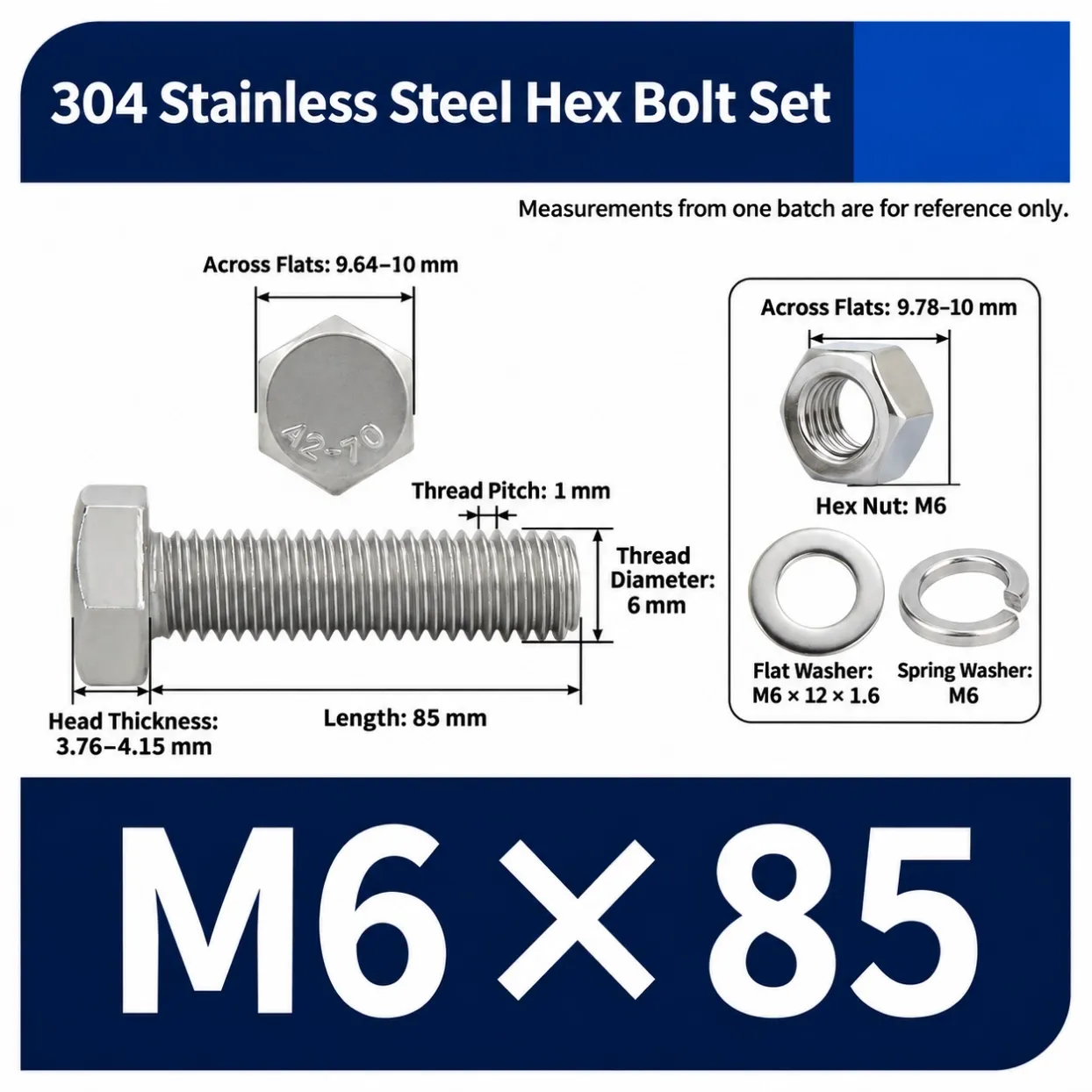
Use 304 stainless steel bolts as a starting point for dry indoor assemblies and mild environments. Consider 316 stainless steel bolts when the joint is exposed to coastal salt spray, road salt, or chloride-containing wash water. For continuous seawater immersion, have the alloy and joint design reviewed before ordering. Salt can collect in the gaps around threads, nuts, and washers, increasing the risk of localized corrosion. Australian Stainless Steel Development Association
304 vs. 316 Stainless Steel Bolts at a Glance
Buying factor | 304 stainless steel bolts | 316 stainless steel bolts |
|---|---|---|
Typical applications | Indoor equipment, enclosures, and general assemblies in mild environments | Coastal outdoor fixtures and equipment exposed to salt spray or chloride-containing wash water |
Chloride resistance | More susceptible to pitting and crevice corrosion | Better resistance to pitting and crevice corrosion |
Common ISO metric designation | A2, such as A2-70 | A4, such as A4-70 |
Upfront cost | Typically lower for comparable bolts | Typically higher for comparable bolts |
The main material difference is molybdenum. It is added to 316 stainless steel to improve resistance to localized corrosion in chloride-containing environments. For buyers comparing quotes, the practical question is how often the installed joint gets wet, what is in that water, and whether salt can build up around the bolt. Outokumpu stainless steel data · Outokumpu corrosion study
When to Choose 304 Stainless Steel Bolts
304 is a practical choice for indoor frames, equipment covers, and general-purpose assemblies that stay mostly dry. It can also suit some outdoor installations in mild environments where salt exposure is low. If the drawing allows either grade and the joint has limited exposure to chlorides, price the 304 option first.
Check the conditions at the joint itself. An indoor bolt on a machine that gets washed down daily can see more moisture and chloride exposure than a bolt on a sheltered outdoor enclosure. Ask what cleaning solution is used and whether it drains away or collects around the fastener. ASSDA guidance on chlorides
When to Choose 316 Stainless Steel Bolts
316 is a better starting point for exposed coastal fixtures, equipment near salted roads, and assemblies that repeatedly come into contact with chloride-containing wash water. It can also be worth pricing when replacing a corroded bolt would mean shutting down a machine or accessing a hard-to-reach joint.
For joints that stay submerged in seawater or trap salty water under washers or inside threads, ask for a material review. Include the expected temperature, exposure conditions, and joint design so the reviewer can assess whether 316 or a more corrosion-resistant alloy is appropriate. ASSDA guidance on seawater exposure · ISO 3506-6 alloy selection guidance
Is a 316 Bolt Stronger Than a 304 Bolt?
For ISO metric fasteners, compare the property class on the drawing or quote. In A2-70 and A4-70, A2 and A4 identify the stainless steel grade, while 70 specifies a minimum tensile strength of 700 MPa for full-loadability bolts covered by ISO 3506-1. Moving from A2-70 to A4-70 changes the stainless steel grade while keeping the same minimum tensile strength requirement. If your drawing calls for a specific alloy such as 316, ask the supplier to confirm that alloy in the quote and provide any documentation your purchase order requires. ISO 3506-1 · Bossard fastener property tables
What to Include in Your Bolt RFQ
To get comparable quotes, send each supplier the same specifications.
- Bolt type and dimensions — head style, diameter, thread pitch, length, and full or partial thread
- Product standard or drawing — include the drawing revision for custom parts
- Material and property class — for example, A4-70, with type 316 specified separately if the drawing requires it
- Matching hardware — nut and washer specifications if you need a complete assembly
- Order details — quantity, required delivery date, and any material documentation or lot traceability requirements If your drawing allows both grades, ask for separate prices at the same quantity and property class. That gives you the actual cost of upgrading to 316 for your assembly.
Browse stainless steel bolts or request a quote with your bolt dimensions, quantity, and service environment.